
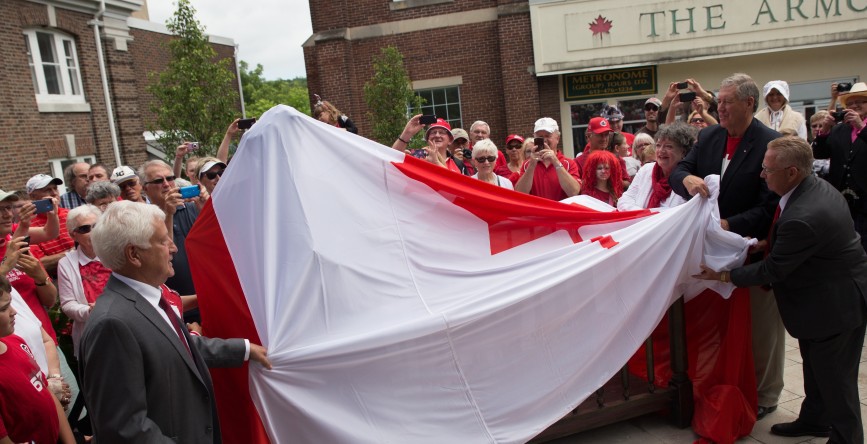
Unveiling and Dedication Ceremony
Speeches at the Unveiling and Dedication Ceremony for the Ruth Abernethy Sculpture Entitled Holding Court — Canada Day 2015
Dedication and Unveiling Ceremony of Ruth Abernethy’s Holding Court, Armoury Square, Picton, 2015.
-
- Prince Edward County Pipe and Drum Band 1:45
- Master of Ceremony Opening Remarks 2:00
- O Canada led by Jeanette Arsenault
-
- Justice Robert Sharpe
-
Macdonald and Canada’s Constitution (2-3 mins)
Sir John A. Macdonald and the Constitution
Canada Day Unveiling of the Macdonald Statue
Picton, July 1, 2015
Robert J Sharpe (OCA)
One hundred and forty eight years ago today, our nation was born when the Westminster Parliament enacted our founding constitution, the British North America Act, 1867
Our country almost certainly would never have been created were it not for the imagination, courage and determination of the man we celebrate today with the unveiling of this statue. From his humble beginnings as a young lawyer here in Prince Edward County, he emerged as an artful statesman. He was, in the words of Richard Gwynn’s biography, our “Nation Maker” – “The Man Who Made Us”. Sir John A considered himself to be a pragmatic politician, a man who said “I am satisfied to confine myself to practical things” rather than “imaginary schemes” or “visionary utopian ideas”. But we know that despite his protestations to the contrary, he did have a dream and a vision – of a strong, united, northern nation that would one day stretch from the Atlantic to the Pacific Ocean, from the Great Lakes to the Arctic.
Our 1867 Constitution bears the marks of Sir John A’s combination of pragmatism and vision. You will search in vain for the grand language of the founding documents of our neighbours to the south. Their Declaration of Independence proclaims the inalienable rights of “life, liberty and the pursuit of happiness” while our Constitution, with typical Canadian reserve, aspires more modestly to “peace, order and good government.” Our 1867 Constitution bore the marks of the compromises and accommodations that Sir John A Macdonald so skillfully forged to unite into one nation the disparate colonies of British North America that felt threatened in the aftermath of the American civil war.
Yet if we read only a little bit between the lines, we can discern our first Prime Minister’s vision for our great country. Our 1867 Constitution proclaims that we are to have “a constitution similar in principle to that of the United Kingdom” and its words and structure binds us to the great tradition of parliamentary democracy of which we remain so proud today. It is a tradition in which Sir John A. flourished. It is the tradition of democratic government, respect for the rule of law, and a firm commitment that all citizens be treated equally with fairness, dignity and respect.
The Constitution Sir John A gave us created a federal state in which our provinces retain significant powers to allow their distinctive differences to flourish. As Sir John A urged the delegates at the 1864 Quebec Conference: “Let us be English or let us be French… but above all let us be Canadians”. Federalism was a compromise. Sir John A knew that he could only go so far to unite us. But Sir John A’s federalism also contains a grand vision – the capacity of different people to come together in a common cause and at the same time agree to respect their differences. That is how we were made and it is who we are today – a united people who have come from every corner of the earth committed to tolerance and respect for the different cultures and traditions of our fellow citizens.
Now today, we are painfully aware that our 1867 Constitution was far from perfect. In particular, we realize that from our founding to the present day we have failed to accord our aboriginal brothers and sisters the place and the respect they deserve as the first Canadians. Some of the things said and done by Sir John A Macdonald were certainly part of that problem. But as a wise judge has said “It is the nature or injustice that we may not always see it in our own times.” Today we acknowledge past wrongs but we must focus our attention on ensuring that the positive side of Sir John A Macdonald’s constitutional vision becomes a reality for all.
It is a vision of a great and vibrant nation, free and democratic, and fully committed to embracing all those who have come to this land from ancient to more recent times to live together in peace and harmony. This is the Canada Sir John A Macdonald imagined, this is the Canada he created, and this is the Canada to which we all continue to aspire.
-
- Treasurer and CEO Janet Minor Law Society of Upper Canada– Macdonald on Women’s Rights and the Connection with the Law Society (2 -3 min.)
-
R.H. Thomson Wilfrid Laurier’s Speech, House of Common June 8, 1891 (6 min.)
Laurier’s speech to the House of Commons on the death of Sir John A. Macdonald, June 8, 1891 R.H. Thomson
Unveiling and Dedication Ceremony of the Ruth Abernethy Portrait of John A. Macdonald, Picton, July 1, 2015
The Fairmont Royal York Hotel Dinner at the 200th Anniversary of the Birth of Sir John A. Macdonald, Toronto, January 10, 2015
“Mr. Speaker. The silence which chokes the honourable gentleman is more eloquent than any human language could be. I fully appreciate also the intensity of the grief which fills the souls of all those who were the friends and followers of Sir John Macdonald at the loss of the great leader whose whole life has been so closely identified with their party.
“We on this side of the House—who were his opponents, who did not believe in his policy, nor in his methods of government—we take our full share of their grief.
“It is in every respect a great national loss, for he who is no more was—in many respects—Canada’s most illustrious son, and in every sense Canada’s foremost citizen and statesman
“At the period of life to which Sir John Macdonald had arrived, death, whenever it comes, cannot be said to come unexpectedly. Some few months ago, during the turmoil of the late election, when the country was made aware that on a certain day the physical strength of the veteran premier had not been equal to his courage, and that his intense labour for the time being had prostrated his singularly wiry frame, everybody, with the exception, perhaps, of his buoyant self, was painfully anxious lest perhaps the angel of death had touched him with his wing. When, a few days ago, in the heat of an angry discussion in this Parliament, news spread in this House that of a sudden his condition had become alarming, the surging waves of angry discussion were at once hushed, and everyone, friend and foe, realized that this time for a certainty the angel of death had appeared and had crossed the threshold of his home. Thus we were not taken by surprise and, although we were prepared for the sad event yet it is almost impossible to convince the unwilling mind that it is true, that Sir John Macdonald is no more, that the chair which we now see vacant shall remain forever vacant—that the face so familiar to this Parliament for the last forty years shall be seen no more, and that the voice so well known shall be heard no more, whether in solemn debate or in pleasant and mirthful tones. In fact, the place of Sir John Macdonald in this country was so large and so absorbing, that it is almost impossible to conceive that the political life of this country, the fate of this country, can continue without him. His loss overwhelms us. For my part, I say with all truth, his loss overwhelms me, and it also overwhelms this Parliament, as if indeed one of the institutions of the land had given way.
“Sir John Macdonald now belongs to the ages, and it can be said with certainty that the career, which has just been closed, is one of the most remarkable careers of this century It would be premature at this time to attempt to fix or anticipate what will be the final judgment of history upon him, but there were in his career and in his life, features so prominent and so conspicuous that already they shine with a glow which time cannot alter.
“I think it can be asserted that in the supreme art of governing men, Sir John Macdonald was gifted as few men in any land or in any age were gifted, qualities which would have made him famous wherever exercised. That he could congregate together the most heterogeneous and blend them into one compact party, and to the end of his life keep them steadily under his hand, is perhaps altogether unprecedented. The fact that during years he retained unimpaired not only the confidence, but the devotion—the ardent devotion and affection of his party– is evidence that beside those higher qualities of statesmanship to which we were the daily witness, he was also endowed with those inner, subtle, indefinable graces of soul which win and keep the hearts of men.
“As to his statesmanship, it is written in the history of Canada. It may be said without any exaggeration whatever that the life of Sir John Macdonald, from the date he entered Parliament, is the history of Canada.
“Although my political views compel me to say that, in my judgment, his actions were not always the best that could have been taken in the interest of Canada, although my conscience compels me to say that of late he has imputed to his opponents motives as to which I must say in my heart he has misconceived, yet I am only too glad here to sink these differences, and to remember only the great services he has performed for our country—to remember that his actions always displayed great originality of views, unbounded fertility of resources, a high level of intellectual conceptions, and, above all, a broad patriotism—a devotion to Canada’s welfare, to Canada’s advancement, and to Canada’s glory.”
Abridged version is 825 words
Original was 1769 words.
Laurier’s speech on June 8, 1891 delivered to the House of Commons was edited by R.H. Thomson, Roderick Benns, Richard Gwyn, David Warrick 2014.
-
- Sir John A. Macdonald (2 -3 min.)
- Master of Ceremony Introduction to the Unveiling
-
Portrait Artist, Ruth Abernethy
Member of Parliament for Hastings and Prince Edward, Daryl Kramp
Treasurer of the Law Society, Janet Minor
Mayor of Prince Edward, Robert Quaiff
Chair of the Macdonald Project, David Warrick
-
Ceremonial gift of Ruth Abernethy’s Holding Court from The Macdonald Project to the Corporation of the County of Prince Edward (Chair Warrick and Mayor Quaiff) (2 min.)
This Is My Canada by Jeanette Arsenault while photo ops taking place
1. Dignitaries and special guests
2. Macdonald Steering CommitteeMC announces free showing of Rocky Mountain Express at the Regent at 3:30 and 5:30 Introduced by Stephen Low, Director and Cinematographer showing one of the greatest engineering feats of all time, the building of a nearly impossible transcontinental railway.
Mayor’s Speech and Birthday Cake to Begin Celebrations
End of ceremony 3:15
Made possible through the generous donations of friends of Macdonald and the financial support of the Government of Canada through the Department of Canadian Heritage.


